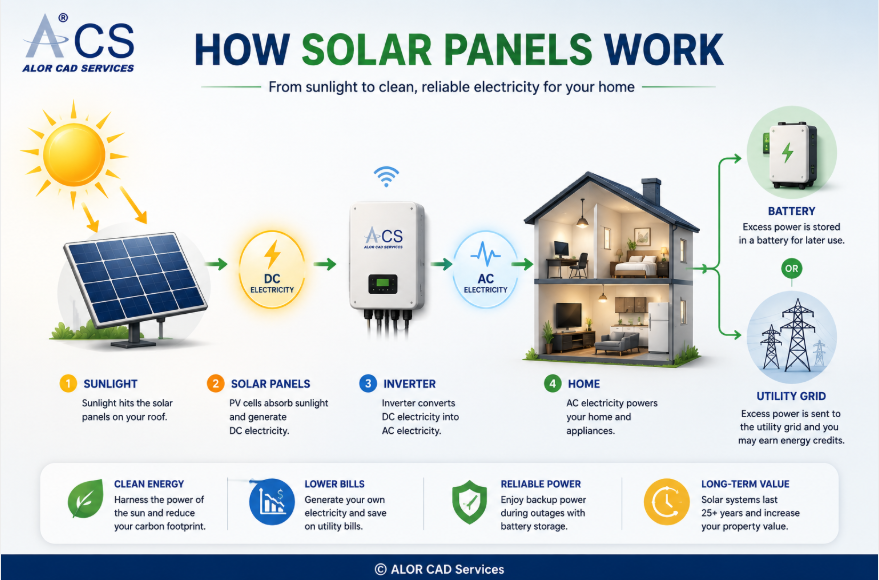
How Do Solar Panels Work?
Have you ever looked at a rooftop solar system and wondered:
“How can sunlight actually power my home?”
This is one of the most searched solar questions by homeowners—and one every solar installer explains regularly.
The simple answer:
Solar panels convert sunlight into usable electricity that powers your home, appliances, batteries, and sometimes sends extra energy back to the grid.
But what really happens after sunlight hits your roof? Let’s break it down.
☀️ How Solar Panels Work
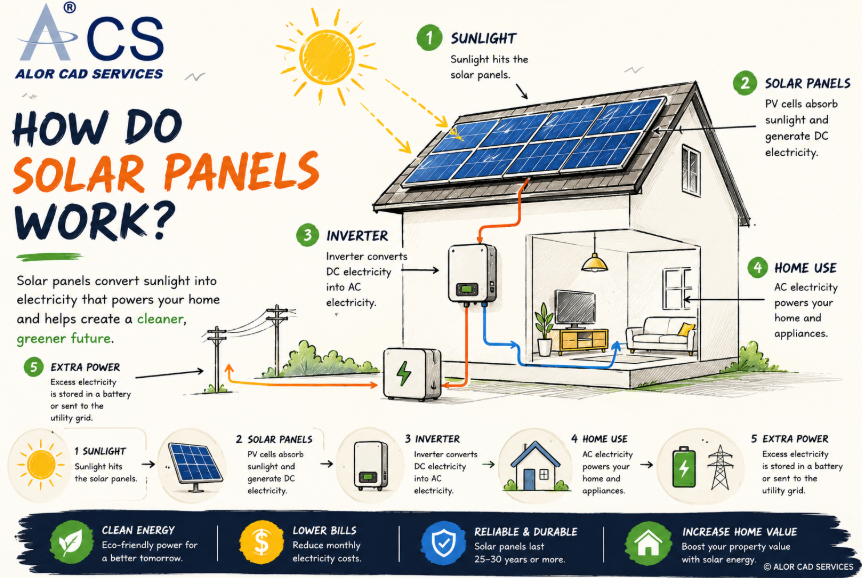
☀️ Sunlight
   ↓
🔋 PV Cells Capture Energy
   ↓
⚡ DC Electricity Is Created
   ↓
🔄 Inverter Converts DC → AC
   ↓
🏠 Home Uses Electricity
   ↓
🔋 Battery OR 🌐 Utility Grid
Step-by-Step: How Solar Panels Generate Electricity
☀️ 1. Solar Panels Capture Sunlight
Solar panels are made of photovoltaic (PV) cells, usually silicon-based.
These cells absorb sunlight (photons).
That sunlight activates electrons.
This begins electricity generation.
⚡ 2. Direct Current (DC) Electricity Is Produced
As electrons move, the panel creates DC electricity.
But homes cannot directly use DC power.
That’s why another component is essential.
🔄 3. The Inverter Converts DC Into AC
The inverter acts like a translator.
It converts DC electricity → AC electricity.
AC power is what your home uses for:
- Lights
- Refrigerators
- Air conditioners
- TVs
- Washing machines
- EV chargers
Without an inverter, solar energy would not be usable in most homes.
🏠 4. Your Home Uses Solar Power First
The system prioritizes your home’s energy use.
This reduces electricity purchased from the utility company.
Result = Lower monthly utility bills.
🔋 5. Extra Electricity Goes Somewhere Useful
If your system generates excess electricity:
It can:
- Be stored in a battery
- Go back to the grid
- Create net metering credits (state-dependent)
🌤 Do Solar Panels Work on Cloudy Days?
Yes.
Solar panels still work on cloudy days.
They rely on sunlight—not heat.
However, output may reduce by 10–25%, depending on:
- Cloud density
- Roof orientation
- Shade
- Weather
- Panel quality
Grid-Tied vs Battery Storage Solar Systems
| Feature | 🌐 Grid-Tied Solar | 🔋 Battery Storage Solar |
| Upfront Cost | Lower | Higher |
| Backup During Power Outage | No | Yes |
| Maintenance | Lower | Moderate |
| ROI | Strong | Higher in outage-prone areas |
| Best For | Standard homes | Energy independence |
| Popular States | MA, NJ, NY, CT | TX, FL, AZ, CA |
This helps homeowners decide based on budget and backup needs.
Why Some Solar Systems Underperform
Even premium solar panels can lose efficiency.
Here’s why:
| Problem | Impact on Solar Performance |
|---|---|
| 🌳 Shade | Blocks sunlight and reduces output |
| 📐 Wrong Roof Tilt | Lower annual production |
| 🌡 High Heat | Reduced panel efficiency |
| 🧹 Dirt & Dust | Reduced sunlight absorption |
| 🔌 Wrong Inverter Size | Poor conversion performance |
| 📏 Poor Layout Design | Lower ROI + permit issues |
This is why engineering matters.
💡 Did You Know?
✔ Solar panels still work in winter
✔ Cooler weather can improve efficiency
✔ Most solar panels last 25–30 years
✔ A poor roof layout can reduce output
✔ Improper design can delay permits
These are common homeowner misconceptions.
Why This Matters to Homeowners vs Solar Installers
| Homeowners 🏠 | Solar Installers 🛠 |
|---|---|
| Lower utility bills | Faster permit approvals |
| Backup power options | Fewer design revisions |
| Higher property value | Better system performance |
| Energy independence | Lower rework costs |
| Long-term savings | Higher customer satisfaction |
This topic serves both audiences.
Why Proper Solar Design Matters More Than People Think
Many people assume:
“All solar systems perform the same.”
That’s not true.
Poor solar design can cause:
- Low power generation
- Permit rejection
- NEC code issues
- Fire setback problems
- Utility interconnection delays
- Roof loading concerns
- Expensive rework
The panel may be good. The design may not be.
How ALOR CAD Services Supports Solar Installers
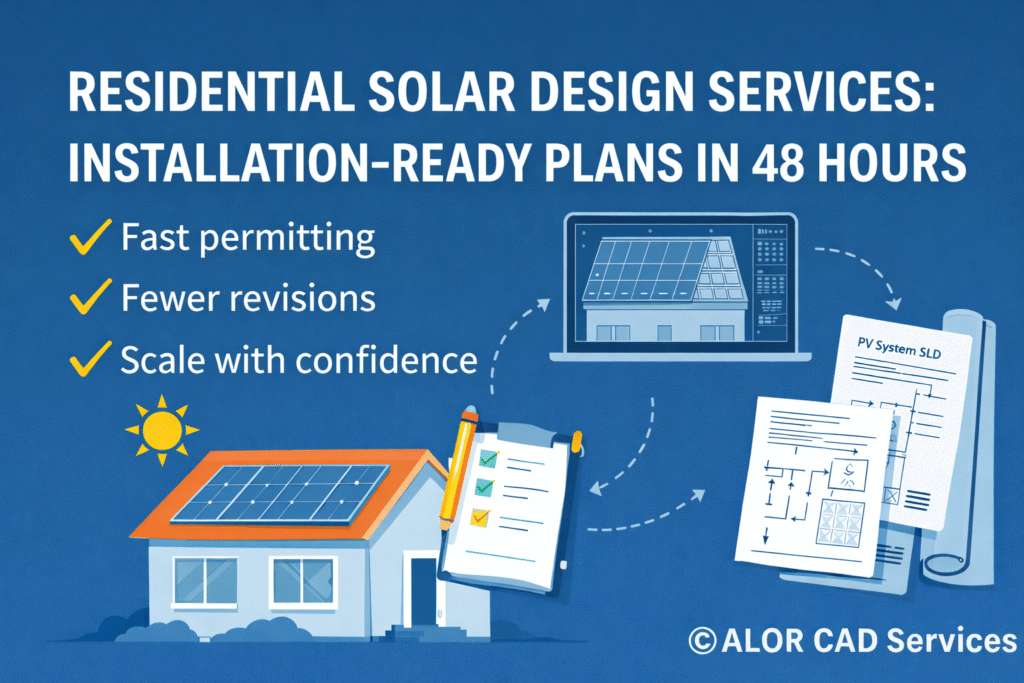
At ALOR CAD Services, we help U.S. solar companies with:
✔ Solar permit-ready drawings
✔ Structural drafting
✔ Electrical line diagrams
✔ PE stamping support
✔ AHJ-compliant layouts
✔ Utility interconnection plans
✔ Residential & commercial solar drafting
This helps installers:
- Reduce turnaround time
- Improve permit approvals
- Scale faster
- Lower internal drafting costs
❓ Frequently Asked Questions
🌙 Do solar panels work at night?
No. They need sunlight. Nighttime power comes from batteries or the utility grid.
☁️ Do solar panels work on cloudy days?
Yes. Output is lower, but they still generate electricity.
❄️ Do solar panels work in winter?
Yes. In fact, cooler weather can improve efficiency.
🧾 How long do solar panels last?
Most quality systems last 25–30 years.
⚙️ Does poor solar design reduce efficiency?
Absolutely. Layout, wiring, tilt, shading, and inverter sizing all affect performance.
🚀 Need Accurate Solar Drafting Support?
ALOR CAD Services supports residential solar installers across the U.S. with:
✔ Permit-ready solar drawings
✔ Structural & electrical drafting
✔ PE stamping support
✔ AHJ-compliant documentation
✔ Utility interconnection plans
Reduce delays. Improve approvals. Scale faster.
Conclusion: Solar Is Simple—But Smart Design Makes the Difference
The process is straightforward:
Sunlight → PV Cells → DC Power → Inverter → AC Power → Home/Grid/Battery
But efficiency, approvals, and ROI depend heavily on good engineering and code-compliant solar design.
Whether you’re a homeowner learning the basics or a solar installer scaling projects, understanding how solar works helps you make better energy decisions.