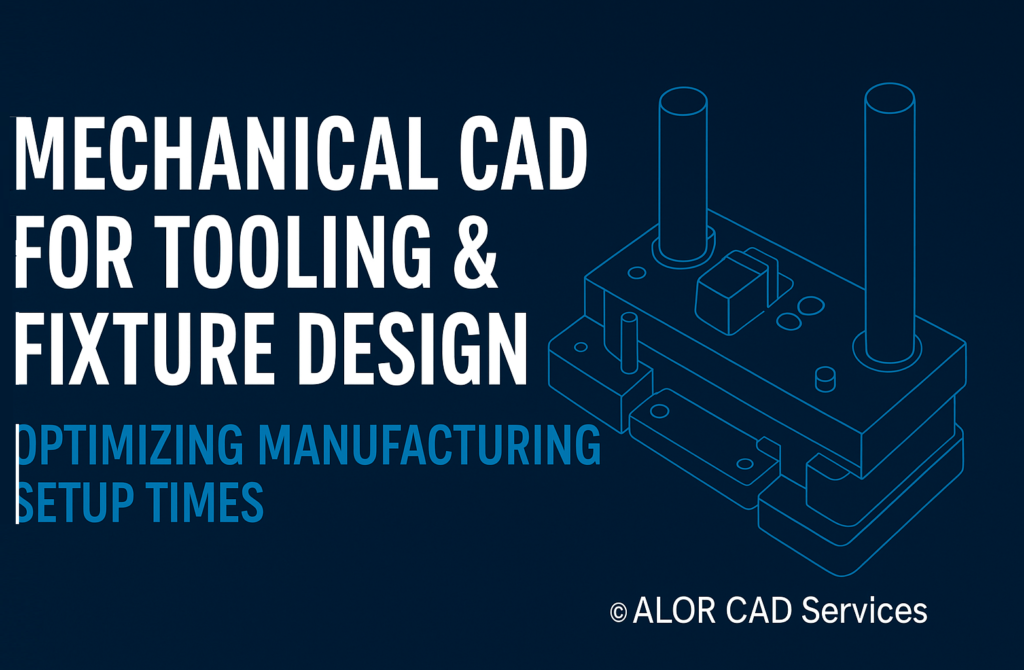
In precision manufacturing, time and accuracy are everything. The faster a company can set up and start production, the more competitive and profitable it becomes. Tooling and fixtures are at the heart of this efficiency, they ensure consistent part quality, reduce operator dependency, and streamline production cycles.
With the help of mechanical CAD design services, manufacturers can now move beyond traditional, time-consuming fixture design processes. CAD-based solutions allow engineers to create, test, and refine tooling designs digitally before they reach the production floor. The result is faster setup times, higher precision, and improved manufacturing throughput.
If your goal is to optimize production workflows and cut setup delays, integrating professional CAD design services is a practical first step.
The Role of Tooling and Fixtures in Modern Manufacturing
Tooling and fixtures serve as the backbone of every production setup. They hold, align, and support workpieces during machining, welding, or assembly. Without precision fixtures, even the most advanced machines cannot maintain accuracy or repeatability.
However, traditional fixture design often involves manual drafting, repetitive testing, and prolonged setup adjustments. Every design change requires time, and every error can cause downtime. This not only affects production schedules but also increases costs due to rework or scrap.
Modern manufacturing demands flexibility and speed. That’s why mechanical CAD design services have become essential. They bring digital precision and automation into fixture design, ensuring every component is modeled for real-world manufacturability and assembly ease.
Why Mechanical CAD Design Services Are Essential
Mechanical CAD (Computer-Aided Design) has revolutionized how tooling and fixtures are developed. Instead of relying on static 2D drawings, CAD allows engineers to visualize, simulate, and modify designs in 3D with incredible accuracy.
Here’s how CAD adds value to tooling design:
- Accurate Modeling: Fixtures fit perfectly with components, minimizing trial and error.
- Faster Revisions: Parametric modeling automatically updates related parts and assemblies.
- CAM & CNC Integration: CAD data integrates seamlessly with CNC and CAM operations.
- Reduced Rework: Digital simulations detect interferences early, reducing costly rework.
By digitizing fixture design, manufacturers can cut lead times, reduce errors, and improve overall productivity.
Optimizing Setup Times with Intelligent CAD-Based Design
Setup time is one of the biggest bottlenecks in manufacturing. Every minute spent adjusting tooling or repositioning parts is lost production time. Mechanical CAD services help eliminate these inefficiencies through intelligent, optimized fixture design.
CAD-driven setup optimization includes:
- Modular Fixture Design: Reconfigurable fixtures for multiple components.
- Quick-Change Mechanisms: Simplified alignment and adjustable clamps.
- Assembly Simulation: Identify setup bottlenecks virtually before production.
- Tolerance Analysis: Validate fits and alignments before machining.
By implementing CAD-driven strategies, manufacturers achieve faster changeovers, higher machine utilization, and smoother production flows.
Design Best Practices for Tooling and Fixture Efficiency
To fully leverage CAD benefits, design must prioritize usability, manufacturability, and efficiency. Expert mechanical drafting services ensure detailed, standardized manufacturing drawings.
Best practices include:
- Using standard components (clamps, bushings, fasteners).
- Designing for operator ease and reduced handling time.
- Incorporating adjustability and flexibility for part variations.
- Adding error-proofing features (Poka-Yoke) to prevent misalignment.
- Ensuring clear 2D documentation from 3D models.
Collaboration and Revision Control in CAD Environments
Version control is a common challenge in manufacturing. Professional CAD systems include PDM (Product Data Management) tools that track revisions and maintain a single source of truth.
This ensures:
- No outdated drawings are used.
- Real-time collaboration between design, production, and QA teams.
- Streamlined communication and fewer production delays.
From CAD to Production – Digital Validation and Prototyping
CAD simulations like motion analysis and FEA (Finite Element Analysis) allow digital validation before production. Engineers can evaluate stress points, load behavior, and overall fixture performance — eliminating weak spots before fabrication.
This digital-first approach means fewer physical prototypes, reduced material waste, and faster design approvals.
Partnering with Professional CAD Experts for Manufacturing Optimization
Outsourcing fixture and tooling design to a professional CAD team like ALOR CAD Services provides immediate efficiency gains. Our mechanical CAD specialists ensure:
- Expertise in multi-axis machining and complex fixture assemblies.
- Compliance with U.S. manufacturing and quality standards.
- Scalable support for both prototype and mass production.
- Access to advanced CAD platforms and experienced drafting professionals.
Ready to reduce setup time and boost production efficiency?
Contact ALOR CAD Services today at 508.978.4628 or visit our Mechanical CAD Design Services page to get started.
Conclusion – CAD-Driven Efficiency for Faster, Smarter Manufacturing
Every second counts in manufacturing. By integrating CAD-based fixture and tooling design, manufacturers gain precision, flexibility, and speed. Mechanical CAD design services streamline setup, minimize rework, and maximize efficiency — keeping production lean and competitive.
FAQs
Q1. How does CAD help reduce tooling setup time?
CAD allows virtual validation, reducing real-world trial and error during setup.
Q2. Which industries benefit most?
Aerospace, automotive, heavy machinery, and precision component manufacturing.
Q3. Can CAD design services modernize legacy tooling?
Yes — reverse engineering converts old fixtures into updatable digital designs.
Q4. Which CAD tools are typically used?
SolidWorks, AutoCAD, Creo, and Siemens NX.