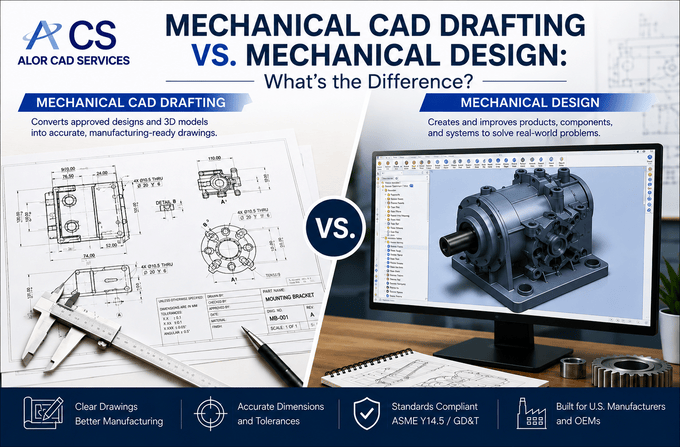
Mechanical CAD drafting and mechanical design are closely related, but they serve different purposes in the product development and manufacturing process. A manufacturer may already have an approved 3D model and need production drawings, while another project may begin with only a concept, sketch, or performance requirement.
Understanding the difference helps U.S. manufacturers, OEMs, engineering firms, and product-development teams choose the right type of support at each stage of a project. It can also prevent unnecessary engineering work, documentation delays, and manufacturing errors.
For companies that already have approved designs and need detailed production documentation, mechanical drafting services can provide targeted support without requiring a full redesign.
What Is Mechanical CAD Drafting?
Mechanical CAD drafting is the process of creating or updating technical drawings from an existing design, CAD model, engineering information, or approved documentation. The objective is to communicate the information needed for manufacturing, fabrication, assembly, inspection, or maintenance.
Typical mechanical CAD drafting work may include:
- 2D mechanical drawings
- Detail and part drawings
- Assembly drawings
- Fabrication and shop drawings
- Section and detail views
- Dimensions and annotations
- Material and manufacturing notes
- Bill of materials (BOM) information
- GD&T and tolerance information when specified
- Drawing revisions and updates
- Legacy drawing recreation or conversion
The drafter’s responsibility is to accurately document the design intent and required manufacturing information. Drafting should not change engineering intent unless the change has been reviewed and approved by the appropriate design or engineering authority.
What Is Mechanical Design?
Mechanical design focuses on developing a product, component, machine, or system so that it meets defined functional, performance, manufacturing, and application requirements. Design work may begin with a concept, sketch, customer requirement, existing component, or problem that needs an engineered solution.
Depending on the project, mechanical design may involve:
- Concept development
- Component and mechanism design
- 3D CAD modeling
- Assembly development
- Material selection
- Design calculations and engineering decisions
- Design for manufacturing (DFM) considerations
- Design changes and optimization
- Product development
- Prototype support
- Engineering documentation
The main purpose of mechanical design is to develop and refine the solution. Once the design is approved, mechanical drafting helps turn that engineering information into controlled technical documentation for production and inspection.
Mechanical CAD Drafting vs. Mechanical Design: What Is the Main Difference?
The simplest way to understand the difference is to ask what the project needs at its current stage: does an existing design need to be documented, or does the product itself still need to be developed?
| Mechanical CAD Drafting | Mechanical Design | Typical Project Need |
|---|---|---|
| Documents an existing or approved design | Develops or improves the design | Existing product vs. new development |
| Focuses on technical drawings | Focuses on product function and requirements | Documentation vs. engineering development |
| Adds dimensions, notes and drawing details | Defines geometry, features and design requirements | Production documentation vs. design decisions |
| Creates manufacturing and assembly documentation | Develops components, mechanisms and assemblies | Release to manufacturing vs. solution development |
| Supports revision and documentation control | Supports product development and optimization | Updating documentation vs. changing the product |
A project may require one service or both. For example, a manufacturer may already have a completed 3D model but need detailed drawings for fabrication and inspection. A new product may require mechanical design first, followed by CAD drafting once the design is approved.
How CAD Drafting Supports Mechanical Design
Mechanical CAD drafting supports the design process by turning approved engineering information into consistent documentation that manufacturing and inspection teams can use.
CAD drafting can support design teams by:
- Turning approved designs into detailed drawings
- Creating manufacturing and assembly documentation
- Updating drawings after approved design changes
- Preparing fabrication and shop drawings
- Maintaining drawing consistency across a project
- Supporting revision control and documentation updates
This division of work can help engineering teams focus on design decisions while drafting resources handle the detailed documentation required to move the project toward manufacturing.
Why Mechanical Engineering Drawings Matter
Mechanical engineering drawings are controlled technical documents used to communicate design information between engineering, manufacturing, fabrication, assembly, and inspection teams. A drawing is more than a picture of a component; it must communicate enough information for the intended downstream use.
Depending on the application, a mechanical drawing may include:
- Accurate dimensions
- Appropriate drawing views
- Sections and details
- Material specifications
- Tolerances
- Manufacturing notes
- Revision information
- Part identification
- Assembly references
- Required annotations and GD&T information
The exact information depends on the purpose of the drawing. A fabrication drawing, for example, may require different information from an assembly or inspection drawing.
When Do You Need Mechanical CAD Drafting?
Mechanical CAD drafting is generally appropriate when the underlying design already exists and the primary need is accurate, controlled documentation.
- A product or component has already been designed and approved.
- A completed 3D model needs to be converted into detailed 2D drawings.
- Existing drawings need updates after approved engineering changes.
- Fabrication or shop drawings are required.
- Assembly documentation needs to be prepared.
- Legacy drawings or sketches need to be recreated in CAD.
- A manufacturing team needs clearer or more complete documentation.
When Do You Need Mechanical Design Support?
Mechanical design support is more appropriate when the product or component still needs engineering development or when the existing design requires substantial changes.
- A new product is being developed.
- An existing product needs a significant redesign.
- A concept or sketch needs to become a manufacturable 3D model.
- Multiple components need to work together as an assembly.
- Design changes are required to improve function or manufacturability.
- A product needs to be developed from a concept.
- Prototype testing identifies a need for design changes.
What Makes Good Mechanical CAD Drafting?
Good CAD drafting is not simply about making a drawing look professional. The drawing must communicate the correct technical information in a clear, consistent, and controlled format.
Strong CAD drawings should focus on:
- Accurate dimensions
- Clear and appropriate drawing views
- Consistent formatting
- Readable annotations
- Appropriate tolerances
- Correct part and material information
- Revision control
- Manufacturing requirements
- Consistency with the approved 3D model or engineering information
For U.S. manufacturing workflows, drawing requirements may also include applicable ASME standards, GD&T, revision practices, and company-specific documentation requirements.
How Mechanical CAD Drafting Helps Manufacturers
Manufacturers often manage large numbers of drawings across different products, revisions, suppliers, and production stages. Internal engineering teams may also have limited time for detailed documentation while new product or production priorities continue.
Outsourced drafting support can help with:
- Large drawing backlogs
- Tight production deadlines
- Drawing updates and revisions
- Legacy drawing recreation
- Production drawing creation
- Engineering documentation
- 2D drafting requirements
- 3D model documentation
- Fabrication and shop drawing preparation
The value of outsourcing depends on choosing a provider that understands technical drawings, file formats, project requirements, manufacturing workflows, and revision control—not simply one that can operate CAD software.
Mechanical CAD Drafting and Design at ALOR CAD Services
For U.S. engineering and manufacturing teams, the right support depends on the project stage and the information already available. ALOR CAD Services can support projects that need mechanical drafting, CAD modeling, documentation, or a combination of these services.
CAD support can be useful for teams that need:
- Production-ready mechanical drawings
- 2D drafting support
- 3D CAD modeling
- Manufacturing documentation
- Assembly drawings
- CAD conversion
- Product development support
Learn more about ALOR CAD Services – Mechanical Drafting Services or contact our team to discuss your project requirements.
Frequently Asked Questions
Is mechanical CAD drafting the same as mechanical design?
No. Mechanical design develops or improves the product or component, while mechanical drafting documents the design through technical drawings and related documentation.
Can a CAD drafter create mechanical designs?
A CAD drafter can document designs and create CAD drawings, but engineering design decisions may require a qualified designer or engineer depending on the project and requirements.
Do manufacturers need both drafting and design?
Often, yes. A product may require mechanical design during development and mechanical drafting after the design is approved for manufacturing, assembly, inspection, or fabrication.
Why are mechanical engineering drawings important?
They communicate dimensions, tolerances, materials, notes, revisions, and other information needed by manufacturing, assembly, inspection, and other downstream teams.
Can existing drawings be converted or recreated in CAD?
Yes. PDFs, paper drawings, sketches, and legacy files can often be recreated or converted into modern CAD formats, depending on the source quality and required output.
Conclusion
Mechanical CAD drafting and mechanical design are different but complementary parts of the engineering workflow. Mechanical design focuses on developing the product and making engineering decisions, while mechanical drafting focuses on accurately documenting approved designs for manufacturing, fabrication, assembly, inspection, and other downstream uses.
For manufacturers, understanding the difference makes it easier to select the right type of support at the right stage of a project. Some projects need drafting only, some require design support, and others benefit from both.
If your team needs production-ready mechanical drawings, CAD modeling, or related engineering documentation, contact ALOR CAD Services to discuss your project, required files, and manufacturing requirements