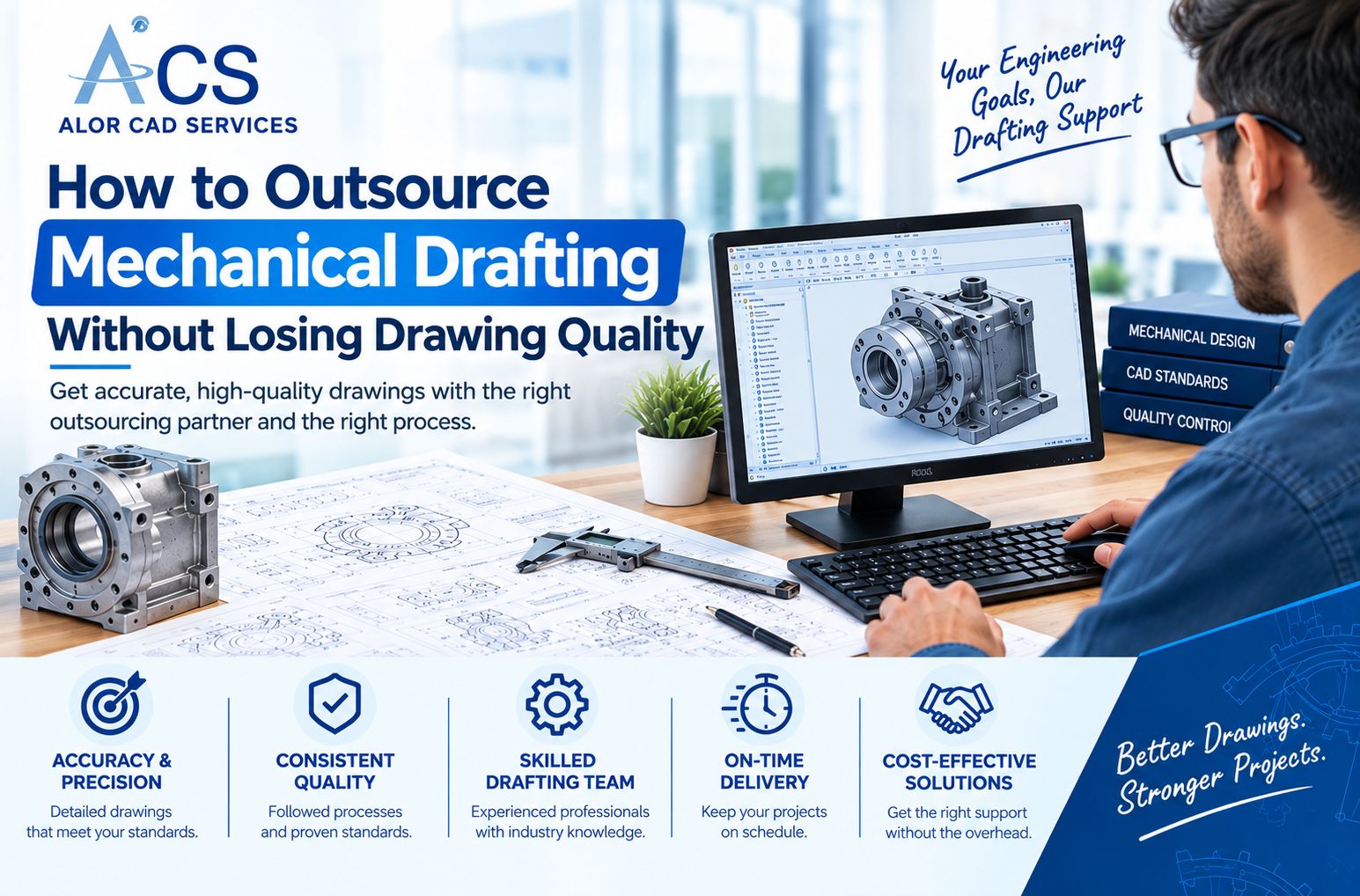
Outsourcing mechanical drafting can help U.S. manufacturers manage drawing workloads without expanding their internal drafting team for every project. However, working with an outside provider requires strong processes to maintain accuracy, consistency, and production readiness across all technical drawings. Successful outsourcing depends on more than selecting a drafting company with CAD software and experienced drafters. Quality relies on a well-managed workflow that covers project requirements, drafting standards, technical reviews, revisions, and final approval. When the process is properly structured, outsourced mechanical drafting can work as an extension of an engineering or manufacturing team rather than becoming another source of rework.
Why Do Manufacturers Outsource Mechanical Drafting?
Mechanical drafting can become a significant part of an engineering workflow. A project may require detailed part drawings, assembly drawings, fabrication documentation, manufacturing drawings, revisions, or updates to existing CAD files.
For an internal engineering team, completing every drafting task in-house can compete with higher-level design and engineering responsibilities. Outsourcing provides additional drafting capacity when workloads increase or when specialized drafting support is needed.
Common reasons for considering mechanical drafting outsourcing include:
- Managing project backlogs without immediately hiring additional full-time staff
- Supporting larger drawing packages during busy production periods
- Updating existing drawings and legacy CAD documentation
- Converting engineering concepts or markups into detailed CAD drawings
- Supporting fabrication and manufacturing documentation
- Providing additional drafting capacity for ongoing engineering projects
The objective should not be to outsource responsibility for quality. Instead, the goal is to extend the team’s capacity while keeping engineering requirements and approval processes under control.
What Can Cause Quality Problems With Outsourced Drafting?
Most quality problems do not come from outsourcing itself. They usually result from unclear requirements, inconsistent standards, weak communication, or insufficient review procedures. A drafting partner may produce a technically neat drawing that still does not meet your company’s requirements. For example, the drawing may use different layer conventions, title block information, dimensioning practices, revision codes, or tolerance requirements. There can also be problems when the drafting provider does not fully understand how the drawing will be used downstream.
A drawing intended for manufacturing or fabrication needs to communicate design intent clearly. Missing information, inconsistent dimensions, unclear details, or incorrect revisions can create questions for production teams and potentially lead to rework. That is why quality needs to be built into the outsourcing process from the beginning.
Start With Clear Drawing Requirements
Before sending a project to an outsourced drafting team, establish exactly what the final deliverables need to contain.
This includes more than simply specifying the file format. Your drafting requirements may include:
- Drawing templates and title blocks
- Units and scale
- Layer and naming conventions
- Dimensioning practices
- Tolerances and GD&T requirements
- Material and finish information
- Revision numbering
- Bill of materials requirements
- Required views and sections
- Output file formats
- Applicable drafting standards
If your company already has established drawing examples, templates, or drafting procedures, provide them as part of the project documentation. This gives the drafting team a practical reference for how your organization expects drawings to look and function.
Choose a Partner With Manufacturing Experience
Mechanical drafting is not simply about reproducing lines and dimensions in CAD software. The drafter needs to understand how technical drawings support engineering, fabrication, machining, assembly, and manufacturing workflows. When evaluating an outsourcing partner, look for experience relevant to your type of work.
Ask whether the team has handled:
- Mechanical parts and assemblies
- Manufacturing drawings
- Fabrication drawings
- Shop drawings
- GD&T and tolerancing
- Sheet metal documentation
- Engineering revisions
- Production-related CAD documentation
Experience with manufacturing workflows can make a significant difference because the drafting team is more likely to recognize what information needs to be clearly communicated for downstream use.
The right partner should also be comfortable working from the types of inputs your engineering team regularly provides, such as CAD files, PDFs, sketches, markups, models, and existing drawings.
Maintain Consistent Drafting Standards
Consistency becomes especially important when drawings are being produced by an external team. If one drawing uses one dimensioning approach and another uses a completely different format, reviewing and maintaining the documentation becomes more difficult. A strong outsourcing workflow should therefore establish a consistent drafting standard before production begins.
Use a Structured Review and Approval Process
One of the most effective ways to protect drawing quality is to establish review points throughout the project. Instead of waiting until an entire drawing package is finished, consider reviewing an initial sample or pilot set first. This provides an opportunity to identify problems with formatting, detailing, standards, or interpretation before the same issue appears across dozens of drawings.
A practical workflow can include:
Project requirements → Initial drafting → Internal review → Corrections → Final QA/QC → Approval → Delivery
The exact process can vary depending on the complexity of the project, but the important point is that quality control should be planned rather than treated as a final formality.
Keep Revision Control Organized
Revision control is another area where outsourced drafting can become difficult if responsibilities are unclear. Manufacturing drawings may go through multiple changes as designs are reviewed, components are modified, or production requirements evolve. If outdated files remain in circulation, the wrong drawing can potentially reach the manufacturing or fabrication team.
Your outsourcing process should clearly define:
- File naming conventions
- Revision numbering
- Revision descriptions
- Approval status
- Superseded drawings
- Markup handling
- Final file locations
Every revision should be traceable so that the engineering team can understand what changed and which version is approved for use.
Make Communication Part of the Workflow
Good communication is particularly important when the drafting team is external. A drafter may encounter an unclear dimension, incomplete markup, conflicting information, or a design detail that requires clarification. Guessing may save time initially, but it can create problems later. A defined communication process gives the drafting team a clear way to raise questions before proceeding.
This can include a designated project contact, standardized markup procedures, review comments, issue tracking, and scheduled project updates. Clear communication also helps reduce unnecessary revision cycles. Instead of repeatedly correcting the same misunderstanding, both teams can establish the expected approach early in the project.
Review the Final Drawings Before Production
Even when an outsourced drafting provider has its own QA/QC process, the final drawings should still go through the client’s approval process. The final review should confirm that the drawings meet the project’s technical and documentation requirements.
Depending on the project, this may include checking:
- Critical dimensions
- Tolerances and GD&T
- Material specifications
- Part and assembly references
- Drawing notes
- Views and sections
- BOM information
- Revision information
- Title block details
- Required file formats
- Consistency with the approved design
The level of review should reflect the complexity and risk associated with the project.
How Should You Evaluate an Outsourced Drafting Partner?
Cost and turnaround time are important, but they should not be the only factors used to evaluate a drafting provider. A stronger evaluation looks at the provider’s ability to consistently deliver drawings that fit your engineering and manufacturing workflow.
Consider asking:
- What types of mechanical drawings does the team regularly produce?
- Can the team follow our existing templates and drafting standards?
- How are drawings reviewed before delivery?
- How are revisions and markups managed?
- Who handles technical questions during the project?
- Can the team support both individual projects and larger drawing packages?
- How are final files organized and delivered?
- Can the provider work with our existing CAD data and documentation?
A small pilot project can also be useful before committing to a larger outsourcing arrangement. It allows your team to evaluate accuracy, communication, turnaround, and the provider’s ability to follow your standards.
When Does CAD Outsourcing Make Sense?
CAD outsourcing can make sense when your internal engineering team has more drafting work than available resources can comfortably handle. Outsourced mechanical drafting can provide additional capacity without requiring a manufacturer to immediately expand its internal drafting department. It can be particularly useful when a manufacturer needs temporary capacity, ongoing drafting support, legacy drawing updates, or additional production documentation without building a larger internal drafting department.
The key is to define what should remain with the internal engineering team and what can be delegated. Design decisions, engineering approvals, and final responsibility may remain internal, while detailed drafting and documentation can be supported by an experienced external team. This creates a more practical division of responsibilities and allows engineers to spend more time on engineering work rather than repetitive drafting tasks.
FAQs
Is outsourced drafting suitable for small manufacturers?
Yes. It provides flexible drafting capacity without adding permanent staff.
Can outsourced drafters work from PDF markups?
Yes, when the markups provide sufficient information for accurate drafting.
How quickly can outsourced drawings be completed?
Turnaround depends on the drawing complexity, quantity, and project requirements.
Can an outsourced team update legacy CAD drawings?
Yes. Existing CAD drawings can be revised or updated when suitable source files are available.
Does outsourcing require changing our CAD workflow?
Not necessarily. A drafting partner can adapt to your existing tools, templates, and processes.
Conclusion
Outsourcing mechanical drafting can help U.S. manufacturers manage workloads without compromising drawing quality. With clear requirements, consistent standards, and reliable review processes, an experienced drafting partner can become an effective extension of your engineering team. Need reliable mechanical drafting support? Contact ALOR CAD Services to discuss your project and find the right drafting solution for your team.